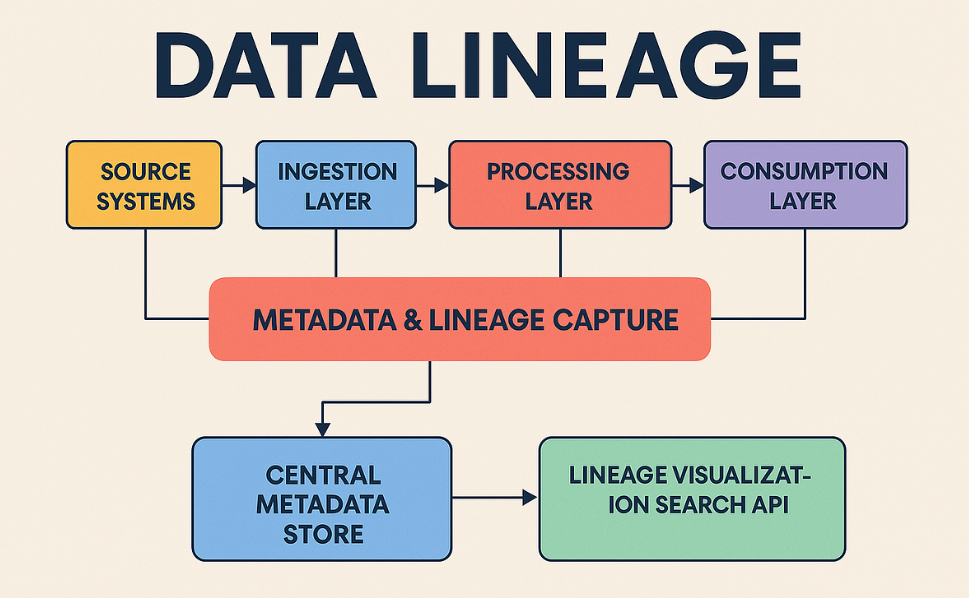
Data lineage and data mapping address distinct but complementary facets of data governance. Lineage reveals origins, movements, and transformations to support trust and accountability. Mapping codifies definitions, semantics, and stewardship roles to enable consistent interpretation across systems. Together, they provide auditable decisions and policy-aligned integration. The question is how to orchestrate both for scalable data ecosystems. The next steps outline practical approaches and governance structures to balance provenance with semantic clarity.
What Data Lineage Really Explains About Data Trust
Data lineage provides a structured map of data’s origins, movements, and transformations, enabling stakeholders to trace provenance and understand how datasets arrive in a given state.
The topic clarifies trust by detailing data provenance and potential error estimation, highlighting where inaccuracies originate and how protections align with governance.
Collaborative assessment guides policy decisions, balancing openness with rigorous verification and accountability for sustainable data stewardship.
How Data Mapping Aligns Systems and Meaning
Mapping data concepts across systems serves to harmonize structures, meanings, and governance requirements, enabling consistent interpretation and interoperability.
Data mapping surfaces alignment needs, clarifies interfaces, and supports collaborative policy design.
It strengthens data governance practices by codifying definitions and stewardship roles, while promoting data interoperability through standardized mappings.
This approach fosters disciplined decision making, scalable integration, and freedom to innovate without sacrificing consistency or accountability.
See also: Data Fabric vs Data Lake Explained
When to Use Lineage vs Mapping (and How They Complement)
When should lineage be prioritized over mapping, and how do the two practices reinforce each other in a governance framework? Lineage emphasizes data provenance and end-to-end traceability, guiding risk and accountability.
Mapping clarifies transformation semantics, ensuring consistent interpretation across systems. They complement by validating lineage with semantic clarity, enabling auditable decisions, policy alignment, and collaborative governance while preserving freedom to innovate.
Practical Frameworks to Implement Both Effectively
Practical frameworks for implementing both lineage and mapping require a structured, governance-driven approach that aligns policy, standards, and operational roles.
The analysis emphasizes collaboration between data governance and data stewardship, defining clear accountability, and integrating risk management with change control.
Concrete artifacts include lineage catalogs, mapping dictionaries, and policy-backed controls, ensuring auditable traceability, interoperability, and sustainable stewardship across ecosystems.
Frequently Asked Questions
How Do Lineage and Mapping Handle Data Quality Issues Differently?
Lineage and mapping address data quality differently: lineage tracks provenance to identify data quality issues upstream and assess impact, while lineage mapping defines transformation rules to enforce quality standards downstream; both support policy-driven, collaborative governance with data quality emphasis.
What Metrics Best Evaluate Lineage and Mapping Effectiveness?
Metrics for lineage and mapping effectiveness include coverage, accuracy, timeliness, and traceability. Juxtaposed visuals contrast completeness with precision, illustrating data provenance and data cataloguing as foundational governance, enabling collaborative, policy-driven decisions while preserving freedom to innovate.
Can Lineage Exist Without Mapping and Vice Versa?
Lineage cannot fully exist without mapping, and mapping without lineage risks gaps; however, both can emerge independently in specific contexts. The assessment should emphasize lineage maturity and mapping dependencies to support an analytical, policy-driven, collaborative governance approach.
Which Tools Support Both Lineage and Mapping Workflows?
What tools support both lineage and mapping workflows? They exist in analytic, collaborative ecosystems guiding data governance and data cataloging, enabling policy-driven collaboration while preserving freedom; organizations evaluate metadata universes to harmonize lineage traces with mapping schemas.
How Do Regulatory Requirements Influence Lineage vs. Mapping Decisions?
Regulators shape data provenance and risk assessment priorities, guiding lineage choices toward traceability and accountability while mapping decisions emphasize standardization. The analytical, collaborative stance recognizes freedom to innovate within policy constraints, aligning governance with risk-aware, compliant data practices.
Conclusion
Data lineage and data mapping together establish a rigorous, policy-driven governance fabric. Lineage provides traceable provenance and risk-aware accountability, while mapping enforces semantic consistency and stewardship ownership. By operating in concert, organizations can audit decisions, ensure regulatory alignment, and sustain interoperable data ecosystems. In a world where data flows resemble complex supply chains, practitioners should adopt a collaborative framework that treats lineage and mapping as complementary, synchronizing trust with meaning—like using a time machine to verify today’s data choices tomorrow. Anachronism: time machine.
